30-Year Mortgage Amortization: Lowering Monthly Payments for Buyers
Understanding Canada's 30-Year Amortization Rules
Managing monthly affordability remains one of the most critical aspects of purchasing a property. Effective December 15, 2024, significant updates to federal mortgage guidelines came into force across Canada, changing how buyers structure their home financing. The expanded availability of 30-year amortizations on insured mortgages provides new options for qualified purchasers who are seeking to reduce their ongoing monthly housing obligations as they enter the housing market.
These policy measures were introduced by the federal government alongside other key adjustments aimed at expanding entry points for homeownership. By giving buyers the choice to spread their principal repayments over a longer period, qualifying purchasers can lower their required monthly outputs and navigate local market dynamics with adjusted monthly budget calculations.
Eligibility Rules and Key Reforms
To understand how a longer amortization schedule fits into your financial roadmap, it is essential to review the eligibility guidelines set out by the federal government. A primary update under these mortgage reforms is extending 30-year amortizations to insured mortgages (loans where the downpayment is less than 20 percent of the purchase price) specifically for two buyer groups:
- First-Time Home Buyers: Purchasers buying their first property qualify for a 30-year amortization schedule on an insured mortgage.
- Buyers of New Builds: Anyone purchasing a newly constructed home can also access a 30-year amortization period for an insured mortgage.
Beyond expanded amortizations, the December 15, 2024 reforms increased the price cap for insured mortgages from $1 million to $1.5 million. For example, on a $1.4 million property, the minimum downpayment required was reduced by up to $165,000. Additionally, under the strengthened Canadian Mortgage Charter, insured mortgage holders can switch lenders at renewal without being subject to another mortgage stress test (minimum qualifying rate). These comprehensive updates were detailed officially by the Department of Finance Canada news release.
The First-Time Buyer Angle: Illustrating the Monthly Savings
For buyers evaluating their entry into the housing market, comparing a standard 25-year amortization against a 30-year schedule demonstrates a noticeable impact on immediate monthly cash flow. Consider an illustrative example involving a $500,000 mortgage balance at a fixed interest rate of 4.5 percent using standard Canadian semi-annual compounding:
- 25-Year Amortization: Results in an estimated monthly payment of approximately $2,767 per month.
- 30-Year Amortization: Reduces the monthly payment to approximately $2,521 per month.
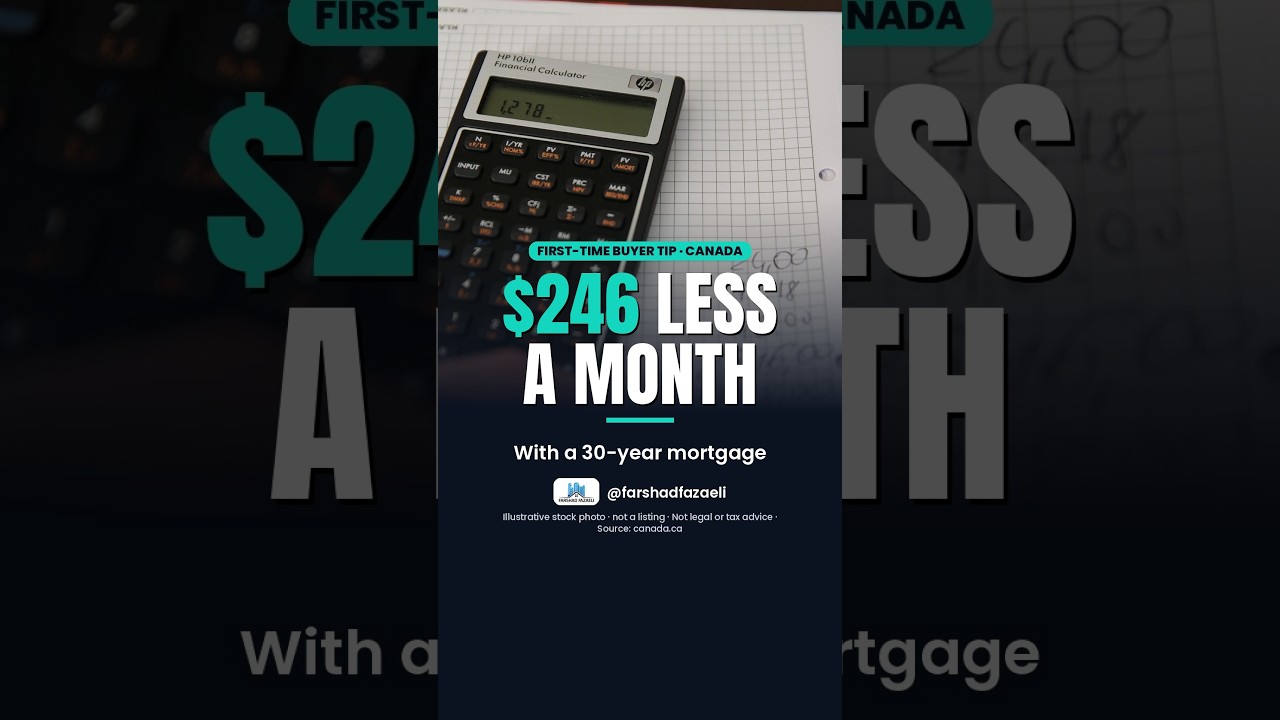
In this mathematical scenario, opting for a 30-year amortization lowers the monthly requirement by roughly $246 per month. For a young professional or family starting out, saving nearly $250 each month can significantly improve cash flow and provide leeway in a monthly balance sheet.
Important Trade-off to Note: While extending the amortization schedule lowers the monthly payment, it also means carrying debt for five additional years. As a result, the total interest paid over the life of the mortgage increases. Your specific rate and lender terms will vary based on your financial profile and choices.
First-time home buyers can also combine extended amortizations with federally backed savings tools. The Tax-Free First Home Savings Account (FHSA) allows qualifying individuals to contribute up to $8,000 per year, up to a lifetime limit of $40,000 tax-free. Furthermore, the Registered Retirement Savings Plan (RRSP) Home Buyers' Plan (HBP) withdrawal limit has been increased from $35,000 to $60,000, letting purchasers access up to $25,000 more from their retirement savings toward a downpayment.
The Seller and Landlord Angle: Market Implications
The implementation of 30-year amortizations and adjusted insured loan caps influences property sellers and prospective real estate investors in several practical ways:
- Expanded Purchaser Pool: Lower monthly payments and higher insured price caps allow prospective buyers who were previously constrained by monthly debt-service ratios to re-enter the market.
- Demand for New Construction: Because all buyers of new builds are eligible for a 30-year amortization on insured mortgages, builder pre-construction projects and newly finished inventory receive targeted demand support. This aligns with federal efforts to support building nearly 4 million new homes.
- Incentives for Multi-Unit Potential: Homeowners looking to add rental capacity can also explore federal support initiatives such as the Canada Secondary Suite Loan Program, which offers access to low-interest loans for property renovations.
The Bottom Line
The expansion of 30-year mortgage amortizations for first-time buyers and newly built homes represents a major structural shift in Canadian home financing options. While a 30-year schedule lowers the monthly financial barrier—such as saving about $246 per month on a $500,000 loan balance at 4.5 percent interest—buyers should carefully evaluate total interest obligations over the lifetime of the mortgage. Aligning amortization lengths, downpayment limits, and savings tools like the FHSA and RRSP Home Buyers' Plan helps create a balanced strategy tailored to your long-term goals.
Questions about your situation? Call or WhatsApp 647-667-5555 or visit fazaeli.ca.
Educational information only, not legal, tax or financial advice. Farshad Fazaeli, Sales Representative, International Realty Firm, Inc., Brokerage.
FAQ
Who is eligible for a 30-year amortization on an insured mortgage?
Effective December 15, 2024, 30-year amortizations on insured mortgages are available to all first-time home buyers and to all buyers of newly constructed homes.
How much can a 30-year amortization lower monthly payments on a $500,000 mortgage?
On an illustrative $500,000 mortgage at 4.5 percent interest (semi-annual compounding), a 25-year amortization costs approximately $2,767 per month, while a 30-year amortization is approximately $2,521 per month. This reduces the payment by about $246 per month.
What is the key trade-off when choosing a 30-year amortization?
While a 30-year amortization lowers your required monthly payment, extending the loan term means paying interest over a longer duration, resulting in higher total interest costs over the life of the mortgage.
What is the updated price cap for insured mortgages in Canada?
Effective December 15, 2024, the federal government increased the price cap for insured mortgages from $1 million to $1.5 million, allowing lower downpayments on homes priced up to $1.5 million.
What limits apply to the FHSA and RRSP Home Buyers' Plan?
Canadians can contribute up to $8,000 per year (up to a $40,000 lifetime limit) to a Tax-Free First Home Savings Account (FHSA). Additionally, the RRSP Home Buyers' Plan withdrawal limit was raised from $35,000 to $60,000.
Do I need to pass another stress test when switching lenders at renewal?
Under the strengthened Canadian Mortgage Charter, insured mortgage holders can switch lenders at renewal without being subject to another mortgage stress test.
Richmond Hill & GTA · International Realty Firm, Inc., Brokerage
647-667-5555 · info@melk.ca