
Understanding Canada's Mortgage Stress Test: Why Your Qualifying Rate is Higher
Your Mortgage Rate vs. Your Qualifying Rate: An Introduction to the Stress Test
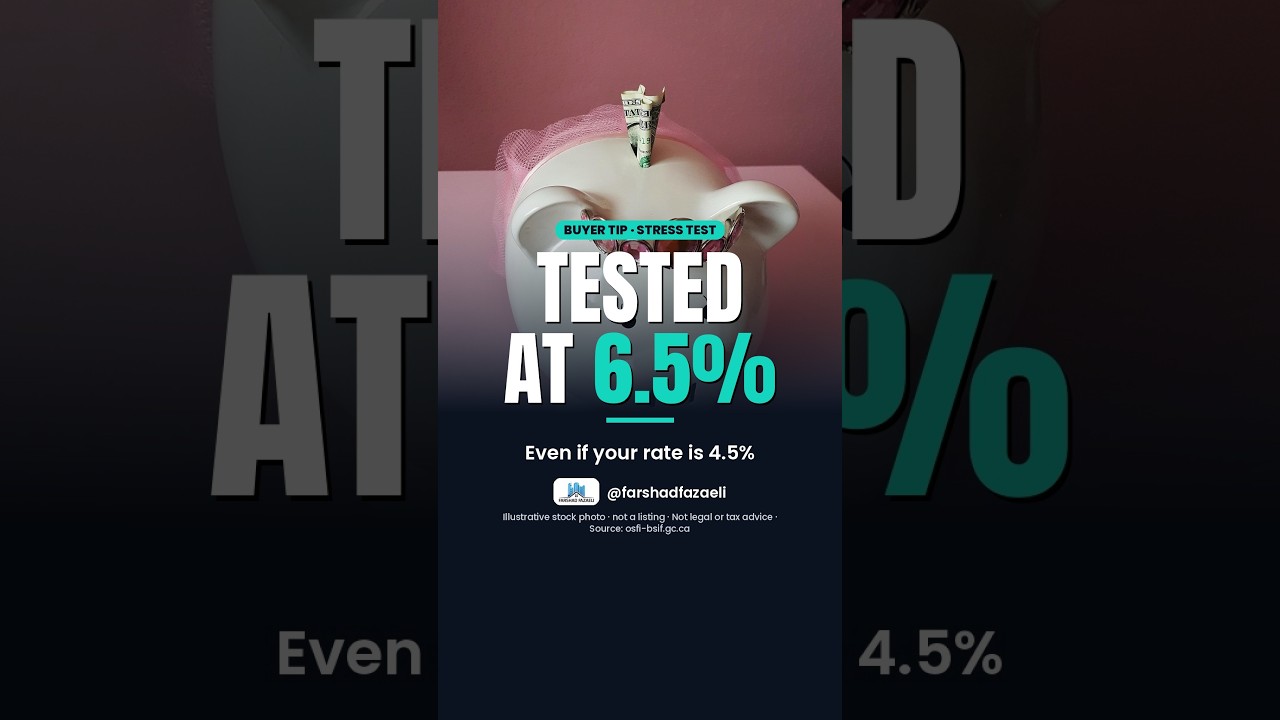
When you're shopping for a home in Ontario, you’ll likely focus on securing the best possible mortgage interest rate. You might be thrilled to get an offer for 4.5%. However, when the lender calculates how much you can actually borrow, they won't use that 4.5% figure. Instead, they’ll use a higher rate—in this case, 6.5%—to “stress test” your finances. This crucial step, officially known as the minimum qualifying rate (MQR), often surprises first-time home buyers, as it directly impacts their purchasing power.
This process isn't a bait-and-switch; it's a fundamental rule in Canadian mortgage lending designed to ensure financial stability for both borrowers and the country's banking system. Understanding how it works is essential for anyone looking to enter the property market. The key thing to remember is that you will pay interest at your actual contract rate, but your borrowing limit is determined by your ability to handle payments at the higher qualifying rate.
How the Mortgage Stress Test Works: The Official Rules
The mortgage stress test is governed by the Office of the Superintendent of Financial Institutions (OSFI) for uninsured mortgages, and the same standard is applied to insured mortgages by the Minister of Finance. The rule is straightforward but has a significant impact.
Your minimum qualifying rate is determined by taking the greater of two values:
- Your mortgage contract rate plus a 2% buffer.
- A floor rate of 5.25%.
Let's look at a couple of examples to see this in action:
- Scenario A: Contract Rate is 4.5%
Your rate (4.5%) + 2% buffer = 6.5%. Since 6.5% is greater than the 5.25% floor, your lender will test your ability to make payments at 6.5%. - Scenario B: Contract Rate is 3.0%
Your rate (3.0%) + 2% buffer = 5.0%. Since 5.0% is less than the 5.25% floor, your lender must use the floor rate. You would be tested at 5.25%.
This calculation is a core part of Guideline B-20, which sets out the underwriting practices for federally regulated financial institutions. The goal is to ensure that you, the borrower, have a sufficient financial cushion.
The Purpose Behind the Test: Protecting Borrowers and the Economy
The stress test was implemented to address several key risks within the Canadian economy. According to OSFI, one of the biggest risks for financial institutions is real estate secured lending. If a large number of borrowers are unable to repay their loans, it could have a significant negative impact on the entire financial system.
The MQR serves as a protective measure by preparing borrowers for potential negative financial shocks. These shocks could include:
- A reduction in household income.
- An unexpected increase in living expenses.
- A rise in mortgage interest rates upon renewal.
This is particularly relevant in an environment of elevated household indebtedness and rising interest rates. By qualifying borrowers at a higher rate, lenders reduce the overall risk of mortgage delinquency and default. As noted in OSFI's guidance, federally regulated lenders hold nearly 80% of all residential mortgages in Canada, making the stability of this sector critical. The stress test is a proactive tool to promote sound mortgage underwriting and contribute to the long-term health of Canada's financial system.
What the Stress Test Means for Home Buyers
For prospective home buyers, the most direct impact of the stress test is a reduction in borrowing capacity. Because your affordability is calculated using the higher qualifying rate, the total mortgage amount you are approved for will be lower than if it were based on your contract rate alone.
This reality may require buyers to adjust their strategies. As OSFI documents suggest, new borrowers might respond by:
- Purchasing a less expensive dwelling: Adjusting expectations to fit a smaller budget.
- Increasing the down payment: A larger down payment reduces the required loan amount, helping to bridge the affordability gap.
- Delaying the purchase: Some may choose to wait and save more money or hope for more favourable market conditions.
While this can feel restrictive, the stress test also provides a valuable safety net. It helps ensure that you are not over-leveraged and can comfortably manage your mortgage payments, even if your financial situation changes or interest rates climb in the future.
Renewals, Refinancing, and the Stress Test
A common question from current homeowners is whether they will have to pass the stress test again when their mortgage term is up for renewal. The rules provide some important flexibility here.
According to OSFI, lenders are not expected to apply the minimum qualifying rate for an uninsured mortgage that is being switched from one federally regulated lender to another at renewal. This is often called a “straight switch.” This exemption applies as long as there is no increase to the loan amount or the amortization period.
However, the situation is different if you plan to refinance. If you are seeking to borrow more money against your home's equity or extend your amortization period, you will likely need to re-qualify under the current stress test rules. This distinction is crucial for homeowners planning their financial future.
The Bottom Line
The mortgage stress test is a non-negotiable part of Canada's real estate landscape. It is not the interest rate you will pay, but rather a prudent financial benchmark used to determine how much you can safely borrow. By ensuring you can afford payments at a rate of your contract rate plus 2% or 5.25% (whichever is higher), the MQR builds a buffer into your finances from day one.
For buyers, this means planning ahead, understanding your true budget, and working with a professional who can navigate these rules. While it may adjust your purchasing power, the stress test is ultimately designed to foster a more stable and resilient housing market for everyone.
Questions about your situation? Call or WhatsApp 647-667-5555 or visit fazaeli.ca.
Educational information only, not legal, tax or financial advice. Farshad Fazaeli, Sales Representative, International Realty Firm, Inc., Brokerage.
FAQ
What is the mortgage stress test in Canada?
It's a rule requiring lenders to check if you could still afford your mortgage payments at a higher interest rate. This rate, called the minimum qualifying rate (MQR), is used to calculate how much you can borrow, not the rate you'll actually pay.
How is the mortgage stress test rate calculated?
You are tested at the greater of two rates: your mortgage contract rate plus a 2% 'buffer,' or the 'floor' rate of 5.25%. For example, with a 4.5% contract rate, your qualifying rate would be 6.5%.
Will I have to pay the higher stress test interest rate?
No. You will make your actual mortgage payments based on your agreed-upon contract rate. The stress test rate is only a hypothetical calculation used by the lender to determine your maximum loan amount.
Does the stress test apply if I renew my mortgage?
According to OSFI, the stress test is not expected for an 'uninsured straight switch at renewal.' This means if you switch lenders without increasing your loan amount or amortization period, you generally won't be re-tested. However, it typically applies to refinancing.
Why was the mortgage stress test introduced?
It was introduced to protect borrowers and the Canadian financial system. It ensures homeowners can handle potential financial difficulties, like a job loss or rising interest rates upon renewal, thereby reducing the risk of widespread mortgage defaults.
Does the stress test apply to both insured and uninsured mortgages?
Yes. The rule set by OSFI for uninsured mortgages (typically those with a down payment of 20% or more) is also applied to insured mortgages by the Minister of Finance, making it a standard across the market.
Richmond Hill & GTA · International Realty Firm, Inc., Brokerage
647-667-5555 · info@melk.ca