
Selling Your Home in Canada: Don't Miss This Crucial Tax Reporting Step
Selling Your Home in Canada: Don't Miss This Crucial Tax Reporting Step
For many Canadian homeowners, the sale of their principal residence is often viewed as a tax-free event. The common understanding is that if it was your primary home, you don't owe capital gains tax, and therefore, there's no need to report the sale to the Canada Revenue Agency (CRA). While it's true that the principal residence exemption can indeed mean you owe $0 in tax on the gain, the assumption that no reporting is required could lead to significant penalties.
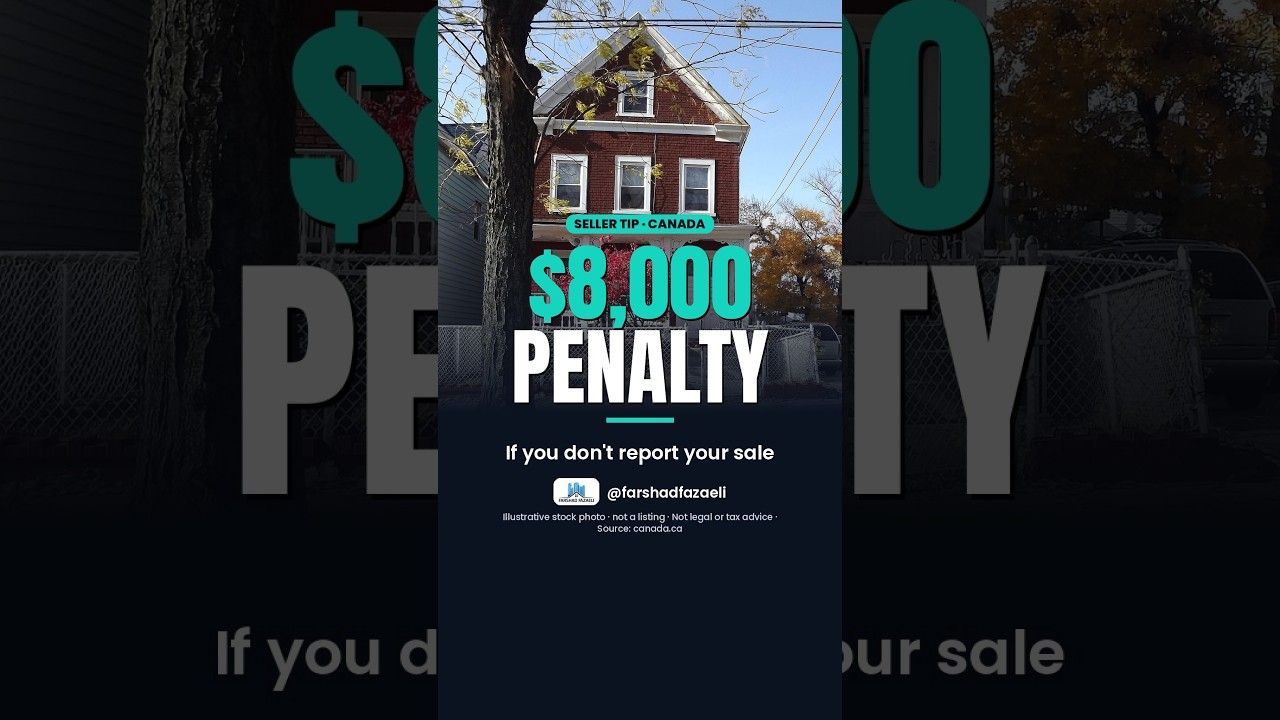
Since the 2016 tax year, the CRA introduced a mandatory reporting requirement for the sale of your principal residence. Failing to comply, even if you qualify for the full exemption and owe no tax, can result in penalties of up to $8,000. As a Sales Representative with International Realty Firm, Inc., Brokerage, Farshad Fazaeli understands the importance of navigating the complexities of real estate transactions, which extend beyond the sale itself to include essential tax compliance. This article will clarify why reporting your principal residence sale is a non-negotiable step for every Canadian homeowner.
The Principal Residence Exemption and Why Reporting is Key
The principal residence exemption is a valuable tax benefit that allows you to avoid paying tax on the capital gain realized when you sell a property that was your principal residence. If the property was solely your principal residence for every year you owned it, you generally do not have to pay tax on the gain. However, the ability to claim this exemption is now contingent on reporting the sale.
Effective for the 2016 tax year and onwards, the CRA will only allow the principal residence exemption if you report the disposition and designate the property as your principal residence on your income tax and benefit return. This means that even if you believe you owe no tax, the sale must be formally declared.
To report the sale of your principal residence, you must complete Schedule 3, Capital Gains or Losses, and Form T2091(IND), Designation of a Property as a Principal Residence by an Individual (Other Than a Personal Trust). If the property you sold was your principal residence for all the years you owned it, or for all but one year, you may only need to complete page 1 of Form T2091(IND).
Defining Your Principal Residence
Understanding what qualifies as a principal residence is fundamental. According to the CRA, your principal residence can be a house, cottage, condominium, apartment, trailer, mobile home, or houseboat. For a property to qualify as your principal residence for any given year, it must meet all of the following conditions:
- It is a housing unit, a leasehold interest in a housing unit, or a share of the capital stock of a co-operative housing corporation acquired only to get the right to inhabit a housing unit owned by that corporation.
- You own the property alone or jointly with another person.
- You, your current or former spouse or common-law partner, or any of your children lived in it at some time during the year.
- You designate the property as your principal residence.
The land on which your home is located can also be part of your principal residence, typically limited to half of a hectare (1.24 acres). However, if you can demonstrate that more land is needed for the use and enjoyment of your home, a larger amount may qualify.
It's important to note that for 1982 and later tax years, you can only designate one home as your family's principal residence for each year. This means that if you and your spouse or common-law partner own separate properties, only one can be designated as the principal residence for the family in any given year.
Navigating the Penalties for Late Designation
Forgetting to report the sale and designate your principal residence in the year of disposition can lead to significant financial consequences. If you realize you've missed this crucial step, it is very important to ask the CRA to amend your income tax and benefit return for that year.
While the CRA may accept a late designation in certain circumstances, a penalty will apply. The penalty is the lesser of the following amounts:
- $8,000
- $100 for each complete month from the original due date to the date your request was made in a form satisfactory to the CRA.
For dispositions occurring in the 2016 and 2017 taxation years, the CRA initially focused on communicating these new requirements. During this communication period, penalties for late-filing a principal residence designation were assessed only in the most excessive cases. However, the rule and potential penalty remain firmly in place for subsequent years.
Beyond the Simple Sale: Special Scenarios
The reporting requirements become even more nuanced in specific situations:
- Not Solely a Principal Residence: If your home was not your principal residence for every year you owned it, you must report the part of the capital gain on the property that relates to the years you did not designate it as your principal residence. This involves completing Form T2091(IND) in full.
- Part Used for Income: If you used only a part of your home as your principal residence and the other part to earn income (e.g., rental or business), you generally have to split the selling price and adjusted cost base between the two uses. You would then report only the gain on the income-producing part on line 13800 of Schedule 3. This split can be done using square metres or the number of rooms, provided the split is reasonable.
- Exception for Income-Producing Use: The CRA may consider the entire property to maintain its nature as a principal residence, even with income-producing use, if all of the following conditions are met: the income-producing use is ancillary to the main use of the property as a residence, there is no structural change to the property, and no capital cost allowance is claimed on the property. An example of this could be a home day care.
- Deemed Dispositions: The reporting rules also apply to "deemed dispositions." A deemed disposition occurs when you are considered to have disposed of property even though you didn't actually sell it, such as when there's a change in use (e.g., converting your principal residence to a rental property, or vice versa). In such cases, you are generally considered to have sold the property at its fair market value and immediately reacquired it for the same amount, and you must report this disposition and designation in the year the change of use occurs.
Given the complexities involved when a property has been rented out, used for business, or if you owned multiple properties, it is highly advisable to consult with an accountant or tax professional. They can provide tailored advice based on your specific circumstances to ensure full compliance with CRA regulations.
The Bottom Line for Canadian Home Sellers
The key takeaway for anyone selling their principal residence in Canada is clear: report the sale to the CRA. Even if you anticipate owing $0 in tax due to the principal residence exemption, this mandatory reporting step is essential to legally claim that exemption and avoid potential penalties of up to $8,000.
Understanding and adhering to these tax reporting requirements is a critical part of a successful home sale. For expert guidance on selling your property in the Greater Toronto Area and ensuring a smooth transaction, Farshad Fazaeli, Sales Representative with International Realty Firm, Inc., Brokerage, is here to assist. While Farshad Fazaeli provides comprehensive real estate services, remember to consult with a qualified tax professional for specific tax advice related to your principal residence sale.
Questions about your situation? Call or WhatsApp 647-667-5555 or visit fazaeli.ca.
Educational information only, not legal, tax or financial advice. Farshad Fazaeli, Sales Representative, International Realty Firm, Inc., Brokerage.
FAQ
Why do I need to report the sale of my principal residence if I don't owe any tax?
The Canada Revenue Agency (CRA) requires you to report the sale of your principal residence on your income tax and benefit return to claim the principal residence exemption, even if no tax is payable. This became mandatory for dispositions in 2016 and later tax years.
Which forms are required to report the sale of a principal residence?
You must report the sale on Schedule 3, Capital Gains or Losses, and also complete Form T2091(IND), Designation of a Property as a Principal Residence by an Individual (Other Than a Personal Trust). If the property was your principal residence for all or all but one year you owned it, you may only need to complete page 1 of Form T2091(IND).
What is the penalty if I forget to report the sale of my principal residence?
If you forget to make this designation in the year of disposition, it's crucial to ask the CRA to amend your income tax and benefit return. The CRA may accept a late designation, but a penalty can apply. This penalty is the lesser of $8,000 or $100 for each complete month from the original due date to the date your request was made in a satisfactory form.
What if I used part of my home to earn rental income or for a business?
If only a part of your home qualifies as your principal residence and you used the other part to earn income, you typically have to split the selling price and adjusted cost base between the two uses. You would then report the capital gain on the income-producing part on line 13800 of Schedule 3. However, the entire property may retain its principal residence nature if the income-producing use is ancillary, there are no structural changes, and no capital cost allowance is claimed.
Can a family designate more than one principal residence for a given year?
For 1982 and later tax years, a family can only designate one home as its principal residence for each year. Before 1982, more than one housing unit per family could be designated.
What is a "deemed disposition" in the context of a principal residence?
A deemed disposition occurs when you are considered to have disposed of a property even if you didn't actually sell it, such as when there's a change in its use (e.g., converting your principal residence to a rental property, or vice versa). In such cases, you are generally considered to have sold the property at its fair market value and immediately reacquired it for the same amount, and you must report this disposition and designation in the year the change of use occurs.
Richmond Hill & GTA · International Realty Firm, Inc., Brokerage
647-667-5555 · info@melk.ca